Training alone is easier when your table tennis robot fits your room, stores without hassle, and still delivers enough control for focused practice. The best compact models combine adjustable spin, speed, placement, and repeatable drills without overwhelming a small setup.
This roundup compares 10 table tennis robots for small spaces, including portable desktop designs and fuller machines with recycling nets, app controls, and extensive preset programs.
Best 10 Table Tennis Robots for Small Spaces Picks for 2026
Most Customizable

- 522 preset drills plus custom programming
- App and remote control with nine spin types
- Compact 18.31-inch length and 150-ball capacity
Best For: Highly customizable solo practice in limited space
Best Recycling Setup

- Recycling net reduces ball pickup
- Adjustable spin, speed, and oscillation
- Requires tables no thicker than 2.5 inches
Best For: Contained home practice with fewer loose balls
Best Dual-Control Option
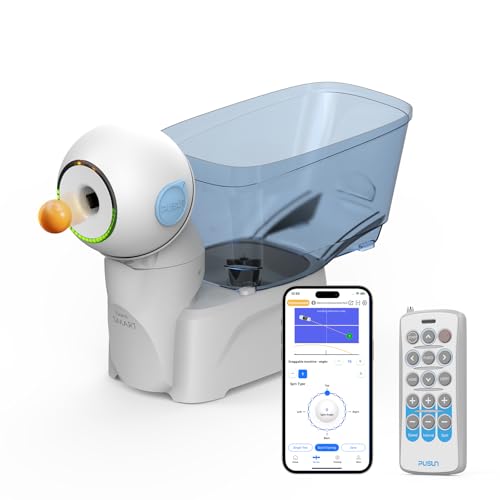
- Triple-motor launching system with nine spin types
- 200-plus preset training drills
- Remote works without Wi-Fi; app adds programming
Best For: Structured solo training with flexible controls
Most Compact

- 12-by-10-by-11-inch listed footprint
- 36 spin combinations for varied practice
- Lightweight 2.4-kilogram portable design
Best For: Basic spin practice where storage space is limited
Versatile App-Controlled Pick

- Includes a ball recycling net
- Offers remote and app control
- Has 264 drills and custom-drill support
Best For: Flexible solo practice across skill levels
Compact Quick-Setup Choice

- Has a 19-by-10-by-11-inch footprint
- Uses a wireless remote without an app
- Adjusts speed, frequency, direction, and spin
Best For: Simple solo training in tighter spaces
Advanced Drill-Capable Option

- Provides 576 pre-saved trajectories
- Adds automatic oscillation and app control
- Programs speed, rotation, landing, and height
Best For: Advanced players seeking highly varied drills
DORA Voice-Controlled Trainer

- Three-motor serving system with full-court landing control
- Preset and customizable drills with app or remote operation
- Ball-recycling net supports longer practice sessions
Best For: Guided solo training with voice features and reduced ball pickup
High-Drill-Count Trainer

- 396 pre-saved trajectories for varied practice
- App and E Pad controls support detailed programming
- Includes a ball-recycling net
Best For: Players seeking extensive preset and customizable drills
Desktop Portable Pick

- Portable tabletop design for full-court solo practice
- 260+ drills with nine spin types and adjustable speed
- Remote use needs no Wi-Fi; app adds advanced controls
Best For: Home practice and coaching in compact setups
Most Customizable – NOVA S Pro Smart Robot
For shoppers comparing table tennis robots for small spaces, the NOVA S Pro offers strong drill variety without requiring a second player. Its 18.31-by-6.93-by-13.39-inch footprint, app and remote controls, and near-net serve option make it practical for focused home practice.
Best For: Players and coaches who want highly customizable solo drills in a relatively compact robot.
Pros:
- Offers 522 built-in preset drills plus custom drill programming.
- Supports nine spin types, adjustable speed, frequency, rotation, height, and landing point.
- Includes both app and remote control, with a 150-ball capacity.
Cons:
- 40mm-plus balls and two AAA batteries are not included.
- Its advanced settings may be more than casual beginners need.
The NOVA S Pro is a feature-rich choice when storage space matters but training flexibility remains a priority. Its one-year warranty and portable design add practical value for regular solo sessions.
Best Recycling Setup – Suz S201 Robot
The Suz S201 is a practical option among table tennis robots for small spaces because its recycling net returns balls to the machine instead of scattering them around the room. It is easy to assemble and provides adjustable spin, speed, oscillation, and serve direction.
Best For: Home users who want continuous practice with less ball pickup and have a compatible table.
Pros:
- Includes a recycling net to reduce ball collection during practice.
- Provides multiple spin, speed, and oscillation adjustments.
- Robot head can be adjusted for direct or indirect serves.
Cons:
- Only works with table-tennis tables 2.5 inches thick or less.
- Needs at least about 20 balls around the feeding tube for proper serving.
- Its listed dimensions are larger than some compact alternatives.
The S201 makes the most sense when ball containment is more important than the smallest possible machine footprint. Confirm your table thickness and allow enough surrounding space for the recycling net before buying.
Best Dual-Control Option – DORA Smart Pro
The DORA Smart Pro combines a triple-motor serve system with remote and app controls, making it a capable pick for table tennis robots for small spaces when the robot can be stored separately between sessions. It supports more than 200 preset drills and standard regulation tables.
Best For: Beginners, intermediate players, coaches, and households wanting guided drills with flexible controls.
Pros:
- Triple independent motors support nine spin types and speeds up to 15 m/s.
- Includes 200-plus drills for forehand, backhand, footwork, and random practice.
- Basic remote operation does not require Wi-Fi; the app adds programming options.
Cons:
- The listed dimensions are 65 by 13 by 25.6 inches, so storage planning is important.
- The supplied details list a 1.5-year warranty, while the title references three years; verify warranty coverage before purchase.
This model is strongest for users who value drill automation and precise serving over a permanently small footprint. Its dual-control setup also makes it easier to begin with simple remote adjustments and move to app programming later.
Most Compact – HP-07 Spin Robot
With listed dimensions of 12 by 10 by 11 inches and a 2.4-kilogram weight, the HP-07 is an appealing choice for table tennis robots for small spaces. It offers 36 spin combinations and is designed for easy installation and portability.
Best For: Players who prioritize a small, portable machine for basic spin-focused practice.
Pros:
- Compact size and relatively light weight make it easy to carry and store.
- Offers 36 spinning-ball options, including topspin, backspin, and sidespin combinations.
- Can provide double-end or optional single serving and includes a one-year warranty.
Cons:
- Requires international-standard 40mm balls, which are not included.
- Needs more than 15 balls to operate and holds about 110 balls in its container.
- The landing point is not fixed, limiting placement-specific drill control.
The HP-07 is a straightforward space-saving option for spin variety and portability. Choose it if compact storage matters more than app control, preset drills, or precise landing-point programming.
Versatile App-Controlled Pick – PONGBOT NOVA S Pro
For shoppers comparing table tennis robots for small spaces, the PONGBOT NOVA S Pro offers a practical all-in-one setup with a recycling net included. Remote and smartphone app controls make it easy to adjust practice without leaving the table.
Best For: Players of different skill levels who want guided drills and customizable practice in a compact home setup.
Pros:
- Includes a ball recycling net to simplify setup and practice.
- Supports remote and smartphone app control.
- Provides 264 pre-saved drills plus custom-drill creation.
- Weighs 4 kg, making it more manageable to position between sessions.
Cons:
- The plastic construction may feel less substantial than a metal-framed option.
- Its listed dimensions may still require dedicated storage space.
The combination of a net, extensive drill library, and custom programming makes this a flexible choice when you want structured solo training without adding separate setup accessories.
Compact Quick-Setup Choice – JOOLA iPong V300
The JOOLA iPong V300 is a straightforward option for table tennis robots for small spaces, with a 19-by-10-by-11-inch footprint and fast assembly. It attaches by twisting on the ball feeder, so there is no app setup or complicated installation.
Best For: Beginners, families, and players who want simple solo training with adjustable speed, frequency, direction, and spin.
Pros:
- Compact listed dimensions suit limited practice areas and storage.
- Wireless remote allows adjustments from the opposite side of the table.
- Controls ball frequency, speed, direction, topspin, and backspin.
- Can serve up to 70 balls per minute, with settings from 30 to 70.
Cons:
- It does not include a recycling net in the supplied components.
- The listed model does not offer app control or pre-saved drill libraries.
Choose the V300 if uncomplicated operation and a smaller footprint matter more than advanced programming. Its remote-controlled adjustments cover the core variables needed for repeatable practice.
Advanced Drill-Capable Option – PONGBOT 576-Trajectory Robot
For players seeking table tennis robots for small spaces with extensive programming, this PONGBOT model offers 576 pre-saved trajectories, automatic oscillation, and remote or app control. Its broad adjustment range supports more varied practice than a basic ball feeder.
Best For: Experienced players who prioritize programmed drills, trajectory variety, and adjustable ball behavior.
Pros:
- Includes 576 pre-saved trajectories for varied training.
- Supports remote and app control.
- Offers automatic oscillation and programmable frequency, speed, rotation, landing, and height.
Cons:
- At 14 kg, it is considerably heavier to move or store than the other listed options.
- The listed height of 42.64 inches may make storage more challenging in a small space.
- The supplied notes do not specify that a recycling net is included.
This is the feature-rich choice for users willing to plan around a heavier, taller unit. Its large trajectory library and programming controls are compelling, but available storage should be checked carefully before buying.
DORA Voice-Controlled Trainer – PUSUN DORA Pro
For shoppers comparing table tennis robots for small spaces, the PUSUN DORA Pro combines preset drills, remote or app control, and a ball-recycling net in one training setup. Its 65-inch length and included collection net make the overall layout worth measuring before purchase.
Best For: Solo players who want guided drills, voice features, and extended practice with less ball collecting.
Pros:
- Three serving motors support stable, precise landing points.
- Preset drills and visual drill customization cover the full court.
- Remote and app controls allow real-time speed, frequency, and spin adjustments.
- Included recycling net reduces repeated ball pickup.
Cons:
- The listed 65-inch length may require careful space planning.
- The supplied notes contain conflicting warranty descriptions: three years in the feature notes and one year in the details.
The DORA Pro is feature-rich for structured solo practice, especially if voice control and ball collection are priorities. Confirm the available footprint and warranty terms before ordering.
High-Drill-Count Trainer – OMNI S Pro
The OMNI S Pro is a practical option among table tennis robots for small spaces when you want a compact robot with extensive drill programming. Its listed 12.59-by-11.81-by-35.04-inch dimensions should still be checked against your table and storage area.
Best For: Adult players who want many ready-made routines plus app-based drill customization.
Pros:
- Includes 396 pre-saved ball trajectories for quick-start practice.
- Remote E Pad S and Pongbot app provide dual-control flexibility.
- Programmable speed, spin, frequency, trajectory, and landing settings.
- Ball-recycling net is included.
Cons:
- 40mm or 40mm+ balls are not included.
- The 35.04-inch listed height may affect storage in tight spaces.
With its unusually large preset library and open drill-sharing features, the OMNI S Pro suits players who prefer variety and customization. Budget separately for compatible balls and verify storage clearance.
Desktop Portable Pick – PUSUN DORA Smart Pro
The PUSUN DORA Smart Pro is designed as a desktop-style portable option for shoppers seeking table tennis robots for small spaces. It can sit on a regulation table and offers remote control without Wi-Fi for basic operation, while the app adds advanced programming.
Best For: Home players, beginners, and coaches needing portable full-table practice with flexible controls.
Pros:
- Triple-motor launching system supports stable serves across the table.
- More than 260 pre-programmed drills cover forehand, backhand, footwork, and random practice.
- Supports nine spin types, speeds up to 15 m/s, and 30–90 balls per minute.
- Includes remote, app control, and a three-year individual-user machine warranty.
Cons:
- The supplied details do not list the robot’s dimensions, so storage fit must be confirmed.
- Advanced programming requires the app, while basic remote use does not require Wi-Fi.
The DORA Smart Pro stands out for portable tabletop use, broad adjustment ranges, and a substantial drill library. Its missing dimensional information is the main consideration for especially tight storage areas.
How We Picked the Best Table Tennis Robots for Small Spaces
We focused on features that matter when floor space and storage are limited: overall portability, ball recycling, control options, drill variety, adjustment range, and setup complexity. Models with remote or app control can be easier to operate during practice, while programmable trajectories and variable spin help players build more targeted sessions.
We also considered whether each robot is better suited to a full-size table, a compact practice area, or desktop-style use. Ball capacity matters because larger reservoirs reduce interruptions, but a smaller hopper may be preferable if the machine must be stored on a shelf or moved frequently.
Quick Comparison
| Feature | What to look for | Why it matters in a small space |
|---|---|---|
| Footprint | Compact body, portable design, or desktop format | Uses less room during setup and storage |
| Ball recycling | Integrated net or collection system | Reduces retrieval time and keeps balls contained |
| Controls | Remote, app, e-pad, or onboard controls | Makes adjustments easier without leaving the table |
| Programs | Preset drills plus custom trajectories | Supports varied practice without extra equipment |
| Capacity | Approximately 150 to 200 or more balls | Allows longer sessions between refills |
Key Buying Factors for Table Tennis Robots for Small Spaces
Measure the Full Setup, Not Just the Machine
Check the robot’s dimensions, net position, table clearance, and the space needed to collect stray balls. A compact machine can still be inconvenient if its recycling net extends well beyond the table or requires a large open area behind it.
Prioritize Ball Control and Recycling
Adjustable speed, spin, frequency, and oscillation are more useful than a long feature list if you want consistent practice. A recycling net is especially valuable in smaller rooms because it reduces ball scatter and shortens reset time.
Match the Controls to Your Routine
App control is convenient for building or saving drills, while a remote can be faster for basic changes. If your device compatibility or wireless setup is uncertain, choose a model with straightforward physical controls or a dedicated controller.
Consider Noise, Storage, and Portability
For apartments, shared rooms, or multipurpose spaces, look for a lighter unit that can be packed away quickly. Also review operating noise and whether the machine needs a permanent net, stand, or table attachment.
Who Should Buy Which Table Tennis Robots for Small Spaces?
Choose a portable or desktop model if you have limited storage, practice occasionally, or need to move the robot between rooms. These designs favor convenience over maximum ball capacity.
Choose a recycling-net model if you want longer uninterrupted sessions and have enough clearance around a regulation-size table. This is often the best balance for frequent solo practice.
Choose an app-controlled robot with programmable drills if you are working on specific serves, returns, footwork patterns, or progressive training plans. Extensive presets are helpful, but custom placement and spin are what make a robot useful as your skill improves.
Before buying, confirm the table dimensions, available clearance, power requirements, included accessories, and compatibility with your preferred balls. The right compact robot should fit your training space first, then provide enough control and variety to keep practice productive.